
Effective Undercarriage Management ensures components achieve a reliable service life with minimal disruption to production. The primary goal is protecting surrounding frames from avoidable damage while keeping costs per hour competitive.
While routine inspections support this objective, the true measure of success is what those inspections help your team achieve. Here are the core measures used to evaluate tracking system performance:
1. Percent Worn at Removal
This measures how worn a component is when you remove it from the machine, as a percentage.
It shows whether you pulled the component:
- Too early, with usable wear material remaining
- Too late, after running it beyond its serviceable life
Running past this limit can damage adjacent parts. It also drastically increases the risk of field failures.
2. Component Life Achieved
This measures the actual operating hours and distance your chains, sprockets, shoes and rolling stock achieve.
We adjust component life to an equivalent life at 100% worn. This gives you a consistent basis for comparison.
As a result, you see the average life you achieve in a given operating environment. You also see whether components deliver the life you expected under those conditions.
3. Planned versus Unplanned Replacements
This records whether you replaced components as scheduled, or whether unexpected wear or failure forced an unplanned replacement.
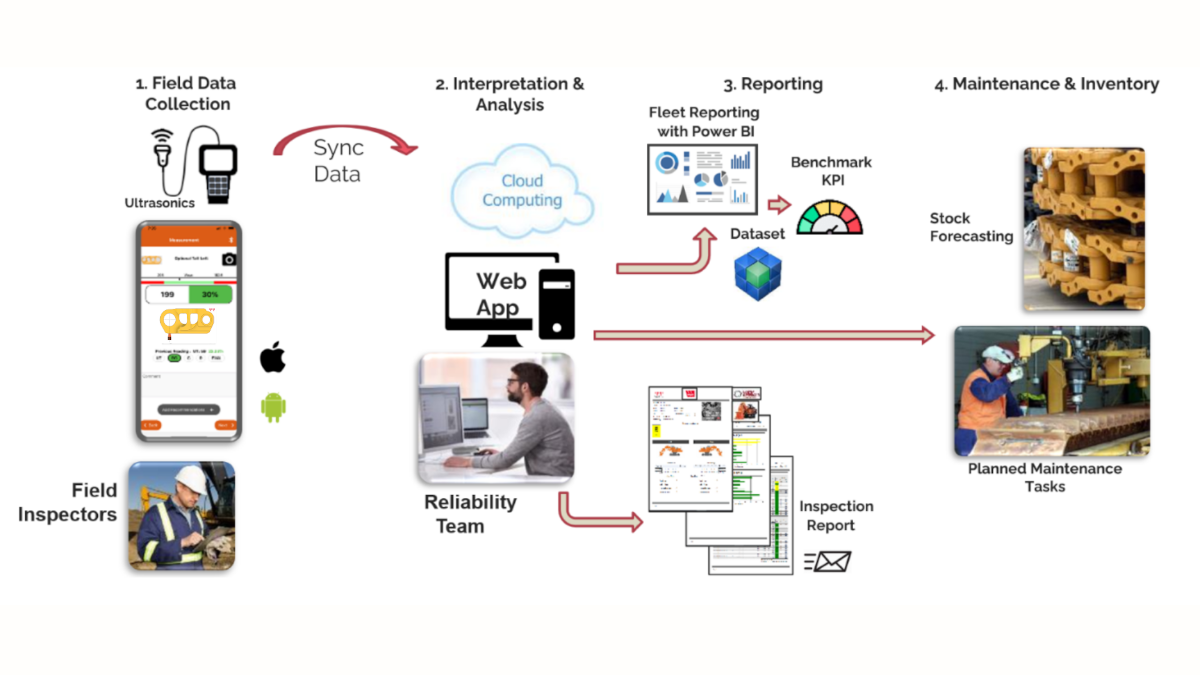
Regular inspections of components and track frames help reliability engineers plan work well ahead of time. Because of this, teams can:
- Order replacement parts without emergency delivery costs
- Schedule labour with less disruption to other tasks
- Allocate workshop bay space
Failures in the field, on the other hand, can substantially increase the total cost of replacement. Emergency machine recovery, lost production and unscheduled repairs all add up. through emergency machine recovery, lost production and unscheduled repairs.
Integrating these steps into a broader undercarriage management strategy ensures that failures in the field can be substantially reduced
4. Cost Per Hour or Kilometer
This measures the total cost of undercarriage components and track frames, including repairs, rebuilds and labour, divided by the operating hours or distance achieved.
Caterpillar says undercarriage can make up as much as half of a dozer’s owning and operating costs. That’s why cost per hour is the KPI to watch.
Distance often gives a more useful basis for comparison. Undercarriage wear links closely to machine travel, while operating hours may include time when the machine sits stationary.
To achieve a low lifecycle cost, select the right combination of components for the operating conditions. Then manage the first three KPIs closely.
5. Midlife Tasks
Crews typically carry these out between 50% and 75% of the undercarriage system’s expected life. They include:
- Idler and roller swaps
- Pin and bush turns
- Shoe regrousering
- Segment replacement
These tasks help balance wear across the system. As a result, more components reach closer to 100% worn before removal.
Plan and schedule them, and track completion so you can spot overdue or missed work.
If you miss these tasks, some components still have usable wear material when you remove the system. That reduces the life achieved and increases cost per hour or kilometre.Plan and schedule them, and track completion to identify overdue or missed work.
6. Identifying accelerated wear
Regular inspections help you identify unusual or uneven wear patterns, oil leaks and other symptoms that a component may be wearing faster than expected.
Next, compare measured wear rates with prior inspections. This confirms whether wear is normal or above average for the fleet on this jobsite and operating conditions.
Early identification lets you investigate and correct the cause before further wear or damage stops the component from achieving its expected life.
When reviewing these measures, keep three points in mind:
- Longer life alone does not mean better management. Running a component beyond its serviceable life can increase frame damage, repair costs and downtime.
- An early removal is not always a poor result. A planned shutdown or an opportunity to replace several components together may justify leaving some wear material unused. Record the reason.
- Compare like with like. Ground conditions, travel distance, machine duty and operating practices affect wear. Fleet averages can hide both good results and problems.
The practical question for effective undercarriage management is: “Are we getting the expected life from each component, knowing when it will need replacing, and acting before it causes additional cost?”
Want these six KPIs tracked across your fleet, in one system? Contact Us.