
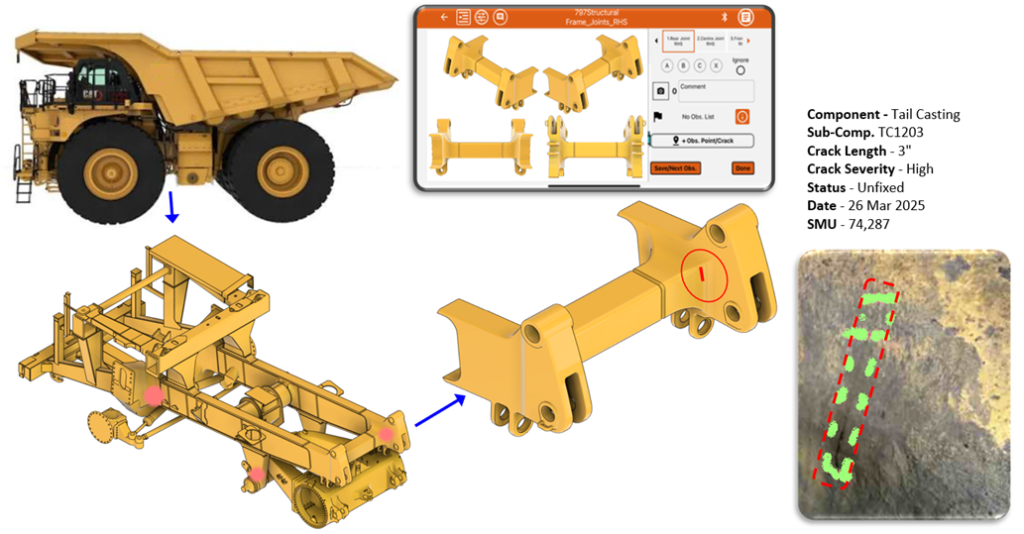
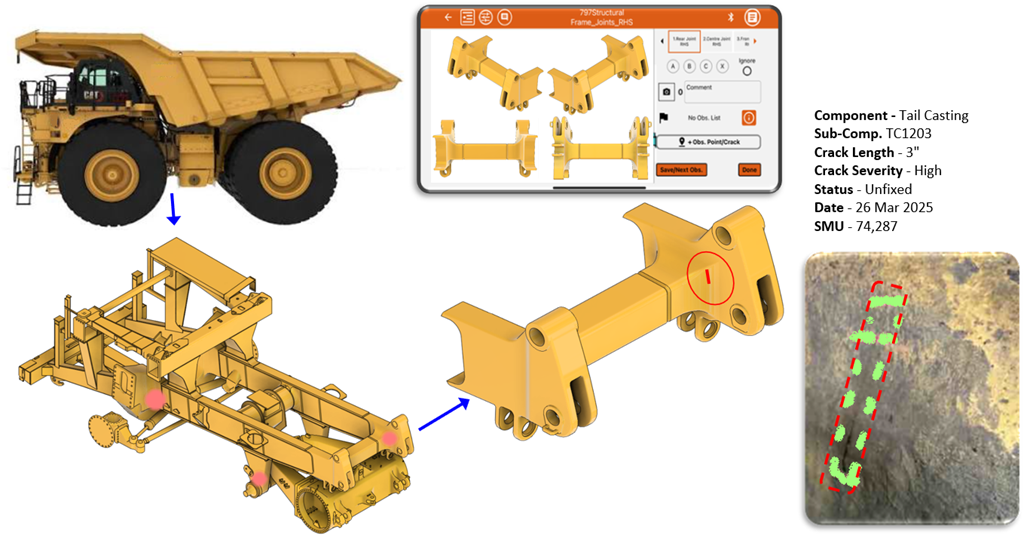
Structural cracking is an ongoing challenge on large mining equipment.
Haul trucks operate under heavy loads, continuous vibration and changing road conditions. Over time, cracks can develop in the chassis and other structural areas. Most mining operations already inspect for these cracks, but the way the information is recorded can make it difficult to manage the problem properly.
A crack may be photographed, marked on a drawing or entered into an inspection report. The repair is then completed, and the machine returns to service.
However, several important questions often remain:
- Has the crack been found before?
- Is it getting longer?
- How quickly is it growing?
- Was it repaired previously?
- Has the repair been successful?
- Are similar cracks developing on other trucks?
- Is the problem isolated, or is it becoming a fleet-wide issue?
This is where digital chassis crack mapping provides real value.
Moving Beyond Paper-Based Inspections
Traditional crack inspections often rely on paper diagrams, photographs, spreadsheets and individual reports.
Each of these may contain useful information, but the complete history is rarely easy to find. Reports can be stored in different locations, cracks may be described differently by each inspector, and it can be difficult to compare one inspection with the next.
Digital crack mapping provides a standard method of recording every crack against its exact location on the machine.
During the inspection, the inspector can record:
- Crack location
- Crack length
- Crack severity
- Photographs
- Inspector comments
- Recommended action
- Repair status
- Maintenance priority
This information is stored against the individual machine and remains available throughout its operating life.
Building a Complete Crack History
A single inspection shows the condition of the chassis on that day.
The real value comes from comparing that inspection with everything previously recorded on the machine.
Each crack can be tracked as:
- Newly identified
- Existing and unchanged
- Increasing in length
- Repaired
- Recurring after repair
- Requiring further engineering review
Previous measurements, photographs, repair details and engineering comments remain attached to the crack location. This gives maintenance and engineering personnel a clear picture of what has happened over time.
Instead of treating every inspection as a separate report, the mine builds a continuous structural history for each machine.
Knowing Whether a Repair Worked
Repairing a crack does not necessarily mean the problem has been permanently resolved.
If the loading conditions or underlying cause remain unchanged, the crack may return in the same area or develop nearby. Without a reliable history, the recurring crack can easily be treated as a new problem.
Digital crack mapping makes it possible to compare the repaired area during every future inspection.
This helps determine:
- Whether the repair remains sound
- Whether the crack has returned
- How long the repair has lasted
- Whether the repair method needs to be reviewed
- Whether additional structural work may be required
This information is also valuable when comparing the performance of different repair methods or repair contractors.
Identifying Problems Across the Fleet
Looking at one truck provides a machine-level view. Combining the information from the entire fleet provides a much broader picture.
Crack data can be filtered by:
- Fleet
- Machine model
- Individual machine
- Chassis area
- Crack severity
- Repair status
- Inspection period
Heat maps can then show where cracks are occurring most frequently across a particular truck model.
If several trucks are cracking in the same location, the problem may be related to chassis design, loading, road conditions, operating practices or the way a particular area is being repaired.
This allows the maintenance team to move from reacting to individual cracks to understanding the wider problem.
Prioritising the Work
Not every crack carries the same risk.
A small stable crack in a lower-risk area may require monitoring, while a growing crack in a critical structural location may require immediate attention.
A digital system allows cracks to be classified by severity and maintenance priority. Outstanding defects can then be viewed across the fleet, helping planners and engineers decide:
- Which machines require urgent attention
- Which repairs can be completed during the next planned shutdown
- Which cracks should continue to be monitored
- Which areas require engineering assessment
- Whether a machine can safely remain in operation
This provides a far clearer maintenance backlog than relying on separate inspection reports.
Improving the Inspection Process
A crack mapping system is not a replacement for experienced inspectors or structural engineers.
Its purpose is to give them better information.
The mobile inspection process provides inspectors with the previous crack history while they are standing at the machine. They can see what was found previously, review earlier photographs and confirm whether the condition has changed.
Using a standard inspection method also improves consistency between inspectors, shifts and sites.
Once the inspection is completed, the information becomes immediately available to maintenance personnel, planners and engineers without having to interpret handwritten notes or search through previous reports.
From Inspection Records to Structural Intelligence
Many mining operations already collect large amounts of crack inspection information.
The challenge is turning that information into something useful.
Digital chassis crack mapping connects each inspection, crack, photograph, repair and recommendation into one continuous record. Over time, this provides a much better understanding of:
- Where cracks are developing
- Which cracks are progressing
- Whether repairs are lasting
- Which machines require attention
- Whether the same problem exists across the fleet
- Where maintenance and engineering resources should be focused
Finding a crack is important.
Knowing where it is, whether it is getting worse, whether the repair worked and whether the same problem is developing on other machines is where the real value begins.
MiningMaintenance #AssetManagement #StructuralIntegrity #CrackMapping #MobileEquipment #MiningTechnology #PredictiveMaintenance #HaulTrucks