
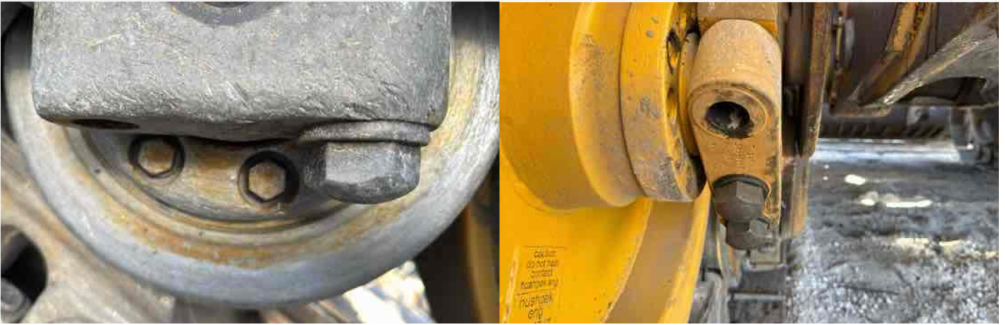
What Undercarriage Hardware Does
Undercarriage hardware includes items such as bolts, idler caps, track roller caps and rubber plugs. These may be relatively small parts, but they help keep the undercarriage complete, correctly positioned and properly secured.
How Missing or Loose Undercarriage Hardware Causes Frame Damage
Missing or loose bolts can allow rollers, idlers and other components to move from their correct position. This can cause misalignment, place additional load on surrounding components and lead to accelerated wear or damage to the undercarriage frame.
Missing caps or plugs can also allow dirt, water and other contaminants to enter areas that should remain protected.
Why Heavy Equipment Frame Inspections Should Include Hardware Checks
An undercarriage frame inspection should therefore include a check to confirm that all required hardware is present, secure and in serviceable condition.
Undercarriage Maintenance Inspection Checklist: What to Record When Hardware Is Missing
Simply replacing the missing hardware may not address the underlying problem. It is also important to record:
- The type of hardware that is missing
- Its position on the machine
- Whether the same hardware has been replaced previously
- How frequently the problem is occurring
- Any movement, wear or damage around the mounting area
- Whether nearby fasteners show signs of loosening, corrosion or stretching
- Whether the issue appears during daily inspections or only after heavy machine operation
- Whether contamination, impact marks or frame movement are visible near the affected area
Common Causes of Repeatedly Missing Undercarriage Hardware
Repeatedly missing hardware may indicate another problem, such as incorrect tightening, damaged threads, excessive vibration, component movement or wear around the mounting point.
For excavators, dozers, drill rigs and other tracked machines, these causes are especially important because the undercarriage carries heavy cyclic loads. A loose bolt may appear minor during a walk-around inspection, but repeated movement can enlarge mounting holes, damage threads and increase vibration through the frame. Over time, this can make the repair more complex than simply replacing the missing item.
Daily Undercarriage Hardware Inspection Guide
A simple daily inspection can help maintenance teams identify loose or missing undercarriage hardware before it causes avoidable downtime. During pre-start checks, operators and inspectors should look for missing caps, missing plugs, loose bolts, polished contact marks around bolt heads, fresh rust trails, oil or grease leakage and visible movement around mounting points.
- Walk around both sides of the machine and compare matching undercarriage components.
- Check track rollers, idlers, guards, caps and plugs for missing or damaged hardware.
- Look for signs of movement, such as shiny wear marks, elongated holes or uneven gaps.
- Record the exact location of any missing hardware so repeat issues can be identified.
- Escalate recurring missing hardware for root cause investigation rather than treating it as a one-off replacement.
How to Prevent Excavator Frame Damage from Loose Bolts
Preventing frame damage starts with more than replacing the missing bolt. The maintenance team should confirm that the correct hardware is being used, check that the mounting area is not worn, verify that threads are not damaged and investigate whether vibration or component movement is causing the hardware to loosen again. If the same bolt, cap or plug continues to go missing, the pattern should be treated as an early warning sign of a structural or alignment issue.
Why Tracking Missing Undercarriage Hardware Matters for Preventive Maintenance
Tracking the location and frequency of missing hardware helps the maintenance team move beyond replacing individual bolts or plugs. It allows them to identify the cause before a small issue develops into premature component wear or more serious frame damage.
Final Takeaway
Small undercarriage hardware can be an early warning sign of larger maintenance problems. When bolts, caps or plugs are missing, the issue should be recorded, investigated and tracked rather than treated as a simple replacement task. By paying attention to these small details, maintenance teams can reduce avoidable wear, prevent frame damage and improve machine reliability.
Summary
- Small undercarriage hardware plays an important role in keeping components secure and correctly positioned.
- Missing or loose bolts, caps and plugs can lead to contamination, misalignment, accelerated wear and frame damage.
- Inspections should record what hardware is missing, where it is located and whether the issue is recurring.
- Repeated hardware loss may point to deeper problems such as vibration, worn mounting points, damaged threads or incorrect tightening.
- Tracking these issues helps maintenance teams identify root causes before minor faults become major repairs.
Need better visibility of recurring undercarriage issues? Start tracking missing hardware before minor faults become major repairs.