Reliability Engineering

Creating Benchmarks for Undercarriage performance

Study of Benchmarks for Undercarriage Management

Last year, we were asked by and Asset Manager seeking insights into the average worn percentage of undercarriage components at their end of life. His aim was to establish key performance indicators (KPIs) to measure his team. This inquiry instigated numerous deliberations regarding the definition of average up to exemplary performance. Given our unique access […]

Study of Benchmarks for Undercarriage Management Read More »

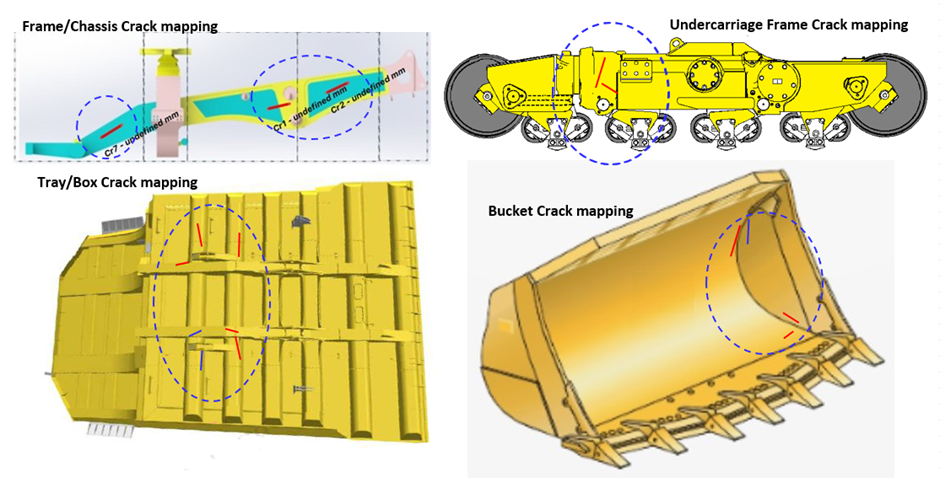
Inspecting and recording cracking on Mobile Field Equipment using a mobile

Cracks occur any many field equipment components. Management of these cracks ensures that catastrophic failure is avoided. Capturing crack data electronically provides some immediate benefits. There are 4 main steps covered for digitizing crack management. Field Inspectors capture, using mobile phones or tablets, the precise position of the crack on the structure by drawing the

Inspecting and recording cracking on Mobile Field Equipment using a mobile Read More »

TrackTreads Wear Management System

Wear Material comes at a higher cost because the components include extra elemental inclusions and further heat treatment in the hardening process. To gain the full benefit from these components requires achieving a full useful life. Any accelerated wear on the component will lead to a shortened life span and lost value. To gain a

TrackTreads Wear Management System Read More »

Scalloping causes more than an uncomfortable ride

Scalloping is where the middle of the Link rail becomes hollowed out. This increases the vibration as the chain moves over the components and can lead to a very uncomfortable ride! Scalloping can be caused by a number of factors: – Idler Rise Heights are provided within the TrackTreads system for easy measurement at each inspection.

Scalloping causes more than an uncomfortable ride Read More »

The Value of Thermal Images in CTS (Custom Track Service) Inspections

The art of managing undercarriage is the early identification and then rectification of accelerated wear in the components. Inspecting and measuring these components, and then comparing the results with previous inspection results allows a comparison of the wear rates. Ideally the components should be achieving between 100 and 110% wear before they need to be

The Value of Thermal Images in CTS (Custom Track Service) Inspections Read More »